
How to Remove Diya Wax & Oil Stains from Clothes After Diwali Puja
"Silk, cashmere, linen, wool — every delicate fabric needs a different touch. Our expert guide ensures your precious garments last a lifetime."
Table of Contents
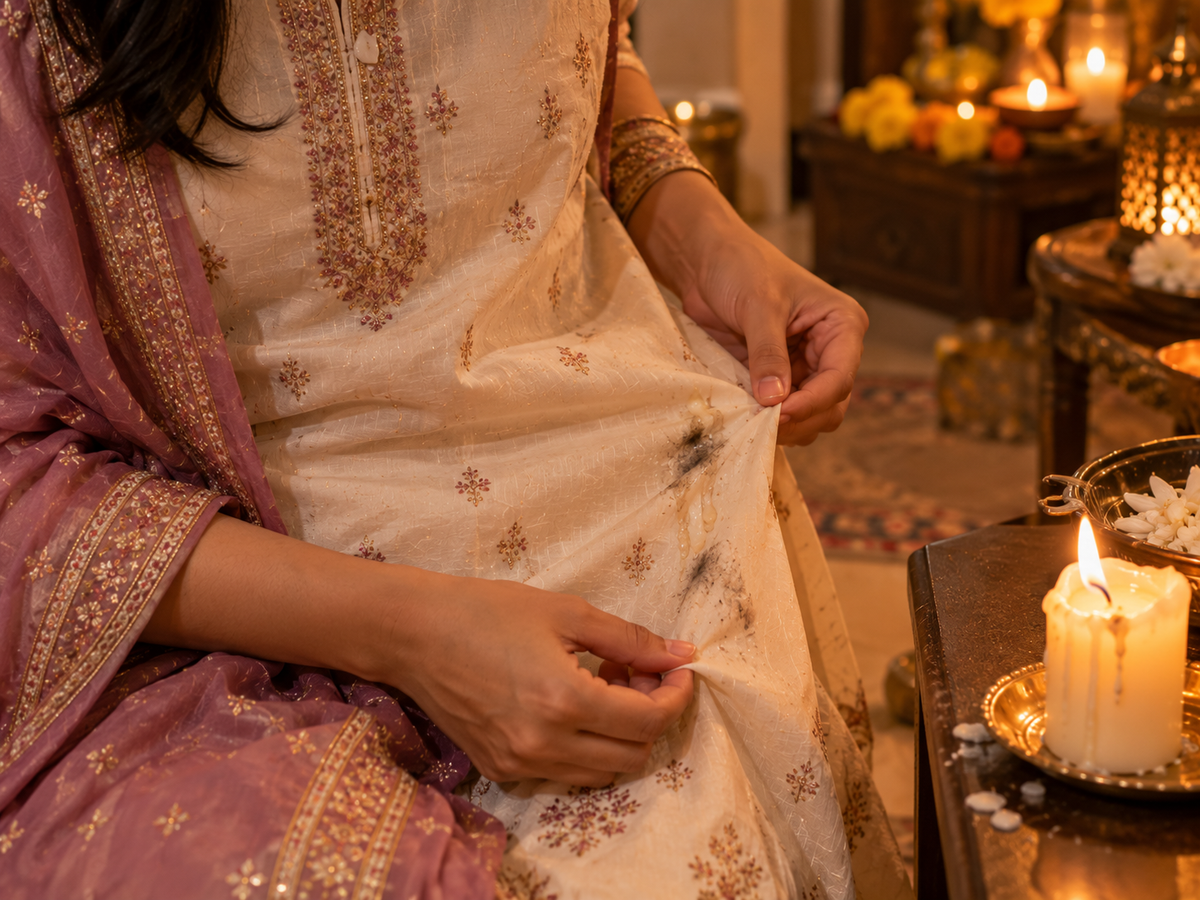
Diya wax and oil stains on clothes need two different treatments. Remove the wax mechanically once it has hardened. Then pre-treat the oily mark underneath and wash it with a detergent suited to your machine.
That order matters. Wash wax while it's still on the fabric and it melts further into the weave. Skip the oil and it stays in the fibres, picks up dust and can turn into a yellow patch over time.
The good news? Both come out when you treat them in the right sequence. Because Daag Achhe Hain, especially the ones that come from lighting diyas with family.
How to remove oil stains from clothes after Diwali puja: the 6-step method
Work through the steps in order. Steps 1 to 3 deal with the wax; steps 4 to 6 deal with the oil stain left behind.
Step 1: Let the wax harden, then scrape it off
Don't touch fresh, warm wax. Wait until it has solidified fully, usually 15–20 minutes at room temperature. Then lift it off with a blunt edge: a spoon, a butter knife or a plastic card. Work from the edges towards the centre, lifting rather than pushing sideways.
Step 2: Freeze any wax left in the weave
If wax remains embedded, place the garment in a plastic bag and freeze it for 30 minutes. Frozen wax turns brittle and cracks off. Scrape again.
Step 3: Lift the final traces with paper and a warm iron
This is the standard method for removing candle wax from fabric. Cover the area with paper towels and press with a warm iron, moving to a clean section of paper as it absorbs the wax. A plain brown paper bag works too. Check the care label first. Don't apply heat to silk; take silk garments to a professional dry cleaner instead.
Step 4: Blot the oil and find the halo
Blot any fresh oil with a clean cloth or paper towel. Don't rub; rubbing spreads oil sideways into clean fabric. Then look wider than the visible mark. Oil spreads outward in a halo that is bigger than the stain you can see.
Step 5: Pre-treat the whole oil zone
For machine washing, use Surf Excel Matic Top Load Liquid or Surf Excel Matic Front Load Liquid Detergent, whichever suits your machine:
• Apply the liquid directly to the stain and the halo around it.
• Rub gently.
• Wait 10–15 minutes.
• Wash. Repeat if needed.
For hand washing or a semi-automatic machine, soak the garment in a solution of Surf Excel Easy Wash Detergent Powder, which supports soaking-based tough stain removal with lesser effort. Follow the pack instructions for soaking.
Step 6: Wash, then check before any heat
Wash with the product approved for your machine, at the dose in the table below, following the garment care label and your machine settings. Look at the garment while it's still damp. If any oily mark or ring remains, repeat steps 5 and 6 before you iron or tumble-dry it. Heat can set a remaining oil stain.
Which Surf Excel detergent suits your wash?
|
Your wash |
Product |
Dosage |
What it brings to oil stains |
|
Hand wash; semi-automatic |
Surf Excel Easy Wash Detergent Powder |
Hand wash: approx. 30 g regular, 45 g heavily soiled. Semi-auto: approx. 45 g regular, 60 g heavily soiled |
High-active surfactant system for robust oily and particulate soil removal; multi-enzyme system for food stains containing proteins, starches, tough fat and gum; soaking support |
|
Hand wash; semi-automatic |
Surf Excel Quick Wash Detergent Powder |
Hand wash: approx. 30 g regular, 45 g heavily soiled. Semi-auto: approx. 45 g regular, 60 g heavily soiled |
High-active surfactant system for robust oily and particulate soil removal; soaking support with lesser effort |
|
Top-load fully automatic; semi-automatic |
Surf Excel Matic Top Load Liquid |
1 cap (approx. 60 g) regular load; 1½ cap (approx. 90 g) large or heavily soiled load |
Multi-surfactant system; approved pre-treatment steps; stain release technology helps washed fabrics release oily soils more easily in subsequent washes |
|
Front-load only |
Surf Excel Matic Front Load Liquid Detergent |
1 cap (approx. 60 g) regular load; 1½ cap (approx. 90 g) large or heavily soiled load |
Multi-surfactant system suitable for front load; lower lather helps avoid damage to machine parts; approved pre-treatment steps; stain release technology |
|
All machines |
Surf Excel Matic Smart Shots |
1 shot regular load; 2 shots heavy load |
Multi-surfactant system; advanced nanolift stain release technology; 3-in-1 benefits: stain removal, long-lasting fragrance and fabric care |
Surf Excel Matic Smart Shots go straight into the drum. Never cut, pierce or apply a capsule directly to a stain, and keep capsules away from children.
How to get candle wax out of clothes without damaging the fabric
Wax is the easier half of a Diwali stain, as long as you never wash it while it's still on the fabric. Hot water melts wax further into the weave. One of the most common mistakes is treating a cotton dupatta with hot water, expecting it to dissolve everything at once. It spreads the stain instead.
• Patience first. Hard wax lifts off cleanly; soft wax smears.
• Lift, don't push. A blunt edge used from the outside in keeps the mark small.
• Low heat only. For the paper-and-iron step, keep the iron warm rather than hot, and move to clean paper often.
• Expect some colour. Coloured wax can leave a dye mark after the wax itself has gone. Treat it with the oil method above, and follow the care label.
Why do diya oil and ghee stains turn yellow?
The oil under diya wax is usually mustard oil, ghee or coconut oil. It soaks into the fibres immediately and spreads outward in an invisible halo. Treat only the visible centre and you get a ring mark after washing.
Oil stains look colourless at first. Over time they attract dust and oxidise, which is how a faint mark turns into a yellow patch weeks after the festival. The longer an oil stain sits, the harder it is to remove.
Ghee needs particular care. It is a food fat, so it sits in the territory of food stains, not just oil. That's why pre-treatment and a proper wash work better than rinsing alone.
How to get oil and ghee stains out of silk or cotton clothes

Fabric decides how far you can go.
• Cotton and linen: Most forgiving. Follow the 6-step method, and wash in warm water if the care label allows.
• Polyester and synthetics: Avoid high heat. Pre-treat promptly, then wash as the care label directs.
• Silk, chiffon and wool: Don't apply heat or rub. Take these garments, including silk kurtas and sarees, to a professional dry cleaner rather than washing them with a Surf Excel product.
Diwali stain care by city: what changes across India
Water hardness and humidity change how a post-Diwali wash goes. Hard water reduces cleaning performance, and humid air slows drying, which makes it harder to check a stain before heat.
|
City |
How Diwali is celebrated |
Hard water |
Humidity (Oct–Nov) |
What to do |
|
Delhi |
Rows of oil diyas and wax candles lit for Lakshmi Puja on Diwali night |
High in groundwater-fed areas: 82% of samples in a South West Delhi study were very hard, above 300 mg/L |
Scrape off wax first. For the oil, use a detergent with hard-water support: builder/alkalinity in the powders, or a chelating agent in the Matic liquids |
|
|
Mumbai |
Oil diyas at doorsteps and on balconies through the five days of Diwali |
Less of a factor than humidity; check your own supply |
High: average evening humidity of about 72% in October and 65% in November |
Check oil marks in daylight while damp, and dry under airflow rather than ironing to speed things up |
|
Kolkata |
Kali Puja on Diwali night, with diyas and candles across homes and pandals |
Less of a factor than humidity; check your own supply |
Remove all candle wax before any wash, pre-treat the oil underneath, then dry fully in a well-ventilated space |
|
|
Bengaluru |
Oil diyas at entrances and ghee lamps for the puja |
High in borewell-fed areas: 25% of samples in a Bengaluru North study exceeded 300 mg/L |
Not the main variable; hard water is |
Choose a product with hard-water support for your machine, and repeat the pre-treatment on stubborn oil and ghee marks |
|
Chennai |
A pre-dawn oil bath (Ganga Snanam) on Deepavali morning, then oil lamps in the evening |
High in coastal groundwater: 64% of samples in a South Chennai study were hard or very hard, linked to seawater intrusion |
Treat oil on towels and clothes the same day, before it spreads and picks up dust, and dry fully before storing |
|
|
Jaipur |
Diyas and candles lighting homes, havelis and markets |
High in groundwater: hardness exceeded the permissible limit in 44% of samples in a Jaipur city study |
Low: average evening humidity of about 31% in October and 34% in November |
Oil dries into fabric quickly in dry air, so blot and pre-treat fast, and use hard-water support in the wash |
How does Surf Excel help with oil stains?
Each Surf Excel product brings its own approved technologies. Here's what they do, in the words of the product sheets:
• High-active surfactant system (Surf Excel Easy Wash Detergent Powder, Surf Excel Quick Wash Detergent Powder): provides robust oily and particulate soil removal by helping the wash liquor break down greasy soils and detach stains from fabric.
• Multi-surfactant system (Surf Excel Matic Top Load Liquid, Surf Excel Matic Front Load Liquid Detergent, Surf Excel Matic Smart Shots): provides robust oily and particulate soil removal by helping the wash liquor break down greasy soils and detach stains from fabric.
• Multi-enzyme system (all five products above): supports removal of targeted everyday soils and broadens cleaning beyond the surfactant system, especially food stains containing protein and starch that can become difficult to remove once dried. In Surf Excel Easy Wash Detergent Powder, this extends to tough fat and gum.
• Builder/alkalinity (powders): binds hardness ions to help protect the surfactant cleaning system, while maintaining pH to facilitate effective tough stain removal during soaking with significantly lesser effort.
• Stain release technology (Surf Excel Matic Top Load Liquid, Surf Excel Matic Front Load Liquid Detergent): helps washed fabrics release oily soils more easily in subsequent washes and can reduce soil redeposition.
• Advanced nanolift stain release technology (Surf Excel Matic Smart Shots): helps washed fabrics release oily soils more easily in subsequent washes and can reduce soil redeposition.
• Anti-redeposition technology (all five products): helps prevent removed soil from redepositing on garments.
Disclaimer: Results vary with stain intensity and age, fabric type and colour, water quality, dosage, wash method and drying conditions. Follow the garment care label and the detergent pack instructions.
Conclusion
Diya wax and oil stains are two jobs, not one. Let the wax harden and lift it off first, then pre-treat the oily halo underneath and wash with the product approved for your machine. Allow for your city's water hardness and humidity, and check every garment while it's still damp before any heat. Done in that order, most post-puja stains don't have to outlast the festival.
Frequently Asked Questions
How do you remove oil stains from clothes after puja?
Blot the oil, then pre-treat the stain and the halo around it. With Surf Excel Matic Top Load Liquid or Surf Excel Matic Front Load Liquid Detergent, apply it directly, rub gently, wait 10–15 minutes, then wash, and repeat if needed. Check the garment while damp before any heat.
How can I get rid of ghee stains on clothes without damaging the fabric?
Blot gently, don't rub, and follow the care label. For hand washing, soak in a solution of Surf Excel Easy Wash Detergent Powder, whose multi-enzyme system supports removal of food stains containing proteins, starches, tough fat and gum. Silk and wool garments should go to a professional dry cleaner.
How do you remove diya wax from clothes without damaging the fabric?
Let the wax harden, scrape it off with a blunt edge, and freeze the garment if wax remains in the weave. Lift the last traces with paper towels and a warm, not hot, iron, after checking the care label. Never iron silk.
How do you get oil and ghee stains out of silk or cotton clothes after puja?
For cotton, follow the 6-step method and wash in warm water if the care label allows. For silk, don't apply heat or rub; take the garment to a professional dry cleaner.
Which detergent removes candle wax and oil stains together?
No detergent replaces removing the wax first. Scrape, freeze and iron off the wax, then treat the oily stain underneath with the product approved for your wash. Surf Excel Easy Wash Detergent Powder is for hand wash and semi-automatic machines; Surf Excel Matic Top Load Liquid and Surf Excel Matic Front Load Liquid Detergent are for those machine types.
Can you remove wax after clothes have been through the dryer or iron?
It's harder, but often possible. Heat pushes wax and oil deeper into the fibres. Scrape off any surface wax, freeze and scrape again, use the paper-and-iron method, then pre-treat the oil stain and wash. Repeat until the mark is gone.
How do I get coloured candle wax out of white clothes?
Remove the wax first with the scrape-freeze-iron method. Coloured wax can leave a dye mark behind, so pre-treat what remains and wash as the care label allows. Some dye marks may not come out fully at home; a professional cleaner is the next step.
How much detergent should I use for heavily soiled Diwali clothes?
Use the heavily soiled dose for your product. For Surf Excel Matic Top Load Liquid or Surf Excel Matic Front Load Liquid Detergent, that's 1½ cap (approx. 90 g) for a large or heavily soiled load. For Surf Excel Easy Wash Detergent Powder, it's approx. 45 g for hand wash or approx. 60 g in a semi-automatic machine. For Surf Excel Matic Smart Shots, use 2 shots for a heavy load.