
How to Remove Sambhar Stains From Clothes: A Step-by-Step Guide
"Silk, cashmere, linen, wool — every delicate fabric needs a different touch. Our expert guide ensures your precious garments last a lifetime."
Table of Contents
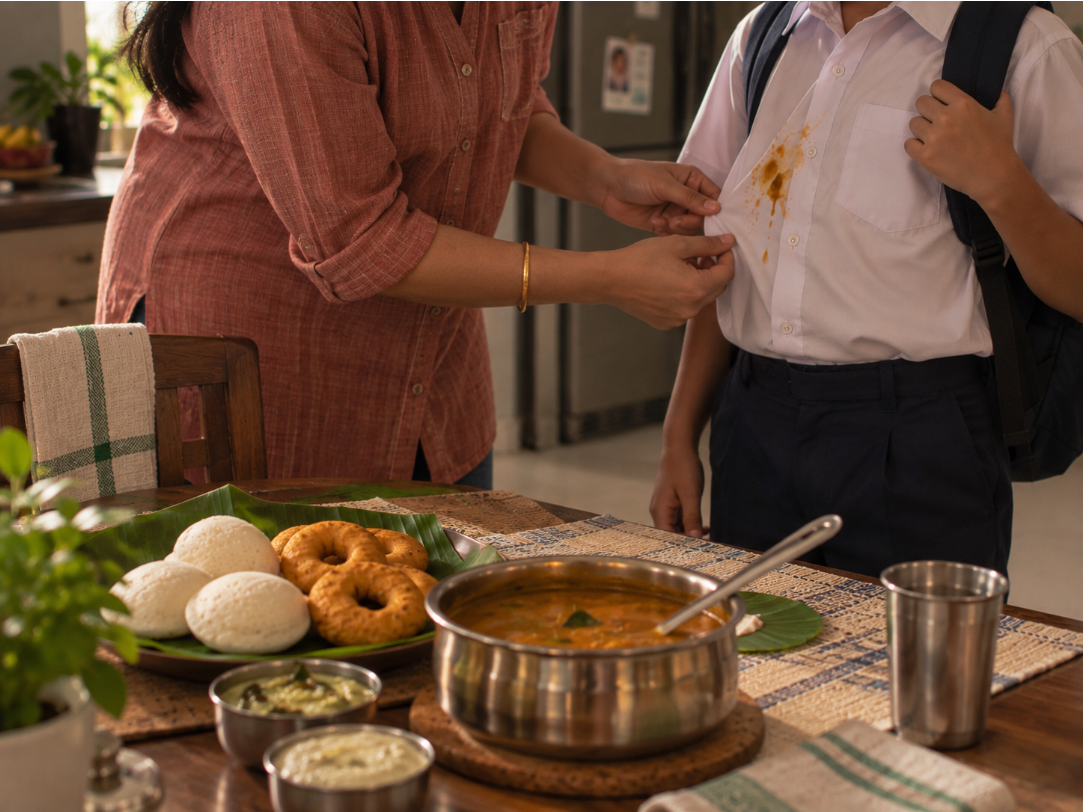
Sambhar gets on more clothes than almost anything else at an Indian breakfast table. Picture a festive morning: the house is buzzing with family, plates are piled with idli, dosa and medu vada, and a wide steel bowl of hot sambhar sits in the middle of the table. Then somebody reaches across for another vada; one quick splash, and there’s an orange mark running down the front of a white shirt.
Most people go straight for the colour. That is the wrong target, and it is why the stain usually wins the first round.
This guide shows you how to remove a sambhar (or sambar) stain the right way. Two things make it harder than an ordinary curry stain, and neither is the colour: the dal dries into something you can’t scrub off, and the tempering oil spreads a halo well past the mark you can see. The right detergent does the hard part. Used as a stain remover for clothes, Surf Excel Easy Wash Detergent Powder works on the dal and the oil that hold the colour in place.
The quick version
|
Why is a sambhar stain harder to remove than a normal curry stain?
A sambhar stain is not just colour. It is several things at once, and the colour is only the part you notice first.
A spill contains cooked dal, tempering oil carrying mustard seeds and curry leaves, tamarind, vegetables, chilli, turmeric, gravy, and whatever else went into the spice powder. It all lands at once, and then it starts drying.
The lentils are the first problem. Sambhar is built on cooked dal. When lentil residue dries on cloth, the proteins and starches form a sticky layer that holds oil, spices and gravy particles against the fibres. The longer it sits, the more firmly that layer settles. Dried dal and gravy won’t respond to scrubbing; attacking hardened residue with a brush will spread the stain sideways or damage the fabric, while the residue stays put. Dried sambhar must be softened before any detergent can work.
Tempering oil is the second problem, and it often goes unnoticed. Once it reaches the surface, oil spreads through the fabric on its own, carrying chilli, turmeric, and the rest of the spice residue outward with it. What you get is a faint, almost invisible halo around the coloured centre. The real spill zone is bigger than the orange mark. Treat only the centre, and the oily ring stays behind, attracts dirt, and shows up after washing as a dull patch around a spot that is otherwise clean.
Tamarind adds a third layer. Most curry stains don’t have it. Tamarind brings acidity, its own natural colour, and food solids that combine with the dal, vegetables and spices to leave a brownish shadow once the liquid has dried.
The colour itself varies more than people expect. Every household’s sambhar powder is different, so you get yellow, orange, red, reddish-brown or dark brown. That is exactly why treating sambhar as a turmeric stain or a “yellow stain” doesn’t work. The colour is the variable. The dal matrix and the oil are the constants.
Cotton makes all of it worse. Cotton absorbs oily food residue and liquid gravy into its fibre structure, so the dal, spice particles, and tempering oil settle deeper than the surface mark suggests. A sambhar spill on a white cotton shirt, a tablecloth, or a napkin needs proper pre-treatment before it goes near the wash.
What should you do the moment it happens?
Two steps come before any detergent, and they matter more for sambhar than for almost any other food stain.
First, lift off the solids. Use a spoon or a blunt edge to remove the vegetables, the cooked dal and any food solids before water goes anywhere near the fabric. Don’t rub; rubbing spreads oily coloured material across a wider area and pushes solid residue deeper into the weave.
Second, if it has already dried, soften it. Wet the stained area thoroughly, or soak the garment briefly in cool water, before you apply any detergent paste. You are softening the hardened lentil, starch and gravy residue so the detergent can reach into it. Fresh, still-wet spills don’t need this.
Don’t fight dried sambhar. Lift the solids, then rehydrate.
How does Surf Excel Easy Wash Powder remove a sambhar stain?
Sambhar needs two cleaning systems at once, because it is oil and cooked food together. Surf Excel Easy Wash Detergent Powder brings both.
Surfactants lift the tempering oil
The high-active surfactant system loosens oily residue, surrounds and lifts greasy material, releases attached food soil, and carries it into the wash water. This matters most for the halo, where the oil has travelled past the visible colour, and nothing else can shift it.
Enzymes break down the dal matrix
Cooked lentils leave proteins and starches on the fabric, and once dry, those residues trap oil, spice and gravy against the fibres. The multi-enzymes in Surf Excel Easy Wash Powder break parts of that matrix into smaller fragments that wash away. They aren’t targeting the colour. They are dismantling the food residue that holds the whole stain in place.
Alkalinity supports both
The powder’s builder and alkalinity loosen greasy food soil and cooked-food residue, and help the surfactants work. That combination matters for sambhar, because you are dealing with oil, cooked lentils, vegetables, spices and gravy solids all at the same time.
It keeps loosened soil suspended
Once everything is detached, the anti-redeposition system keeps it suspended in the wash water, so it rinses away instead of settling back onto the garment.
How to remove a sambhar stain: the 8-step method

Work through the steps in order. The sequence is what makes it work.
Step 1: Lift off the solids first
Use a spoon or a blunt edge to lift the vegetables, cooked dal, and any food solids off the fabric before water goes near it. Don’t rub; rubbing spreads oily coloured material and pushes solid residue deeper into the weave.
Step 2: If it has dried, soften it first
This step determines whether the rest works. Wet the stained area thoroughly, or soak the garment briefly in cool water (about 15 to 30 minutes) before applying any detergent paste. This softens the hardened lentil, starch, and gravy residue so the detergent can reach it. Fresh, still-wet spills don’t need this.
Step 3: Flush from the reverse side
Turn the garment inside out. Hold the reverse side under cool running water so it pushes the loose residue back out in the direction it came from, rather than driving it further through the fibres. Keep going until the water stops carrying away food residue.
Step 4: Make a Surf Excel Easy Wash Powder paste
Mix a little Surf Excel Easy Wash Detergent Powder with water to make a smooth paste, roughly three parts powder to one part water. Check the garment care label and follow the instructions on the pack.
Step 5: Treat the whole spill zone, not the centre
Cover the visible orange, red, yellow or brown mark. Then cover the dried lentil and gravy residue, the outer edge of the colour, and the oily halo around it. Don’t stop at the centre; the tempering oil went further than the colour, so extend the pre-treatment past the area that looks stained. Work the paste gently across the whole zone, without hard scrubbing.
Step 6: Let the detergent work
Leave the paste on for about 15 to 20 minutes so the surfactants can loosen the oily tempering residue and the enzymes can start on the cooked-lentil matrix. Don’t let the paste dry out completely on the garment.
Step 7: Wash the garment
Wash the whole garment with Surf Excel Easy Wash Detergent Powder, following the pack directions and the care label. For a hand wash, use about 30 g for a regular load or 45 g for a heavily soiled one. For a semi-automatic machine, use about 45 g for a regular load or 60 g for a heavily soiled one. This wash does the main work.
Step 8: Check before any heat
Look at the garment while it is still damp, and check the area around the original mark. You are checking for a faint oily ring, a dull patch, dried food residue, and any remaining orange, red or brown colour. If anything is left, repeat the pre-treatment before you iron it or put it in the dryer. Heat sets the remaining food and oily residue, making the next attempt much harder.
Quick tips and common mistakes
Do this
-
Act fast, because cooked lentil and gravy residue gets much harder once it dries.
-
Remove the food solids before you add water.
-
Soak anything that has already dried to soften the dal, starch and gravy first.
-
Flush from the back, not the front.
-
Treat a wider area than it looks like you need to because the oily halo runs past the coloured centre.
-
Take extra care with cotton, which absorbs sambhar and gravy residue more deeply than synthetics.
-
Check before ironing or drying, and repeat if a mark remains.
Avoid this
-
Going straight for the colour instead of the dal and oil holding it in place.
-
Scrubbing dried sambhar hard, which spreads oil and colour over more fabric.
-
Treating only the centre and leaving the oily halo behind.
-
Using hot water or applying heat before the stain is fully gone.
What actually causes a sambhar stain?
Most people file sambhar under spice stains, or colour stains. It is neither.
A sambhar stain is cooked dal, tempering oil, tamarind, vegetables, spices, and gravy. The colour gets noticed first. The dried lentil matrix and the hidden oily halo are what make it persist.
Surf Excel Easy Wash Detergent Powder tackles both through its surfactants, enzymes, and alkaline cleaning environment. It removes the food matrix gripping the fabric, so the colour has no reason to stay.
So the strategy isn’t complicated; it is just not what most people do. Soften what has dried. Treat beyond what you can see. Then wash away the whole spill.
Results vary with the stain’s intensity and age, the fabric type and colour, water quality, dosage, wash method and drying conditions. Always follow the garment care label and the detergent pack instructions.
Frequently asked questions
Can a dried sambhar stain still be removed?
Often, yes, but you have to soften it first. Wet or soak the dried area in cool water (about 15 to 30 minutes, longer if it is really set) to rehydrate the hardened dal, starch and gravy, then work in a Surf Excel Easy Wash Powder paste and wash. Dried sambhar often needs two or three rounds. Never scrub it dry, and never iron over it.
Does this method work on cotton kurtas and school uniforms?
Yes. It works well on everyday washable cottons and common synthetics, whether you hand wash or use a semi-automatic machine. Cotton absorbs oily, gravy residue more deeply, so pre-treat it and treat beyond the visible mark. For silk, wool or delicate pieces, check the care label and use a professional dry cleaner instead.
Why does a sambhar stain sometimes come back as a dull patch after washing?
Because the oily halo was left behind. The tempering oil spreads past the colour into a faint ring, and if you treat only the centre, that ring stays in the cloth, collects dirt, and shows up later as a dull patch. Treat the whole spill zone, not just the coloured mark.
Why should you flush from the reverse side instead of the front?
Because flushing from the back pushes the loose residue back out the way it came in, rather than driving it deeper through the fibres. Turn the garment inside out and hold the back of the stain under cool running water until it stops carrying residue away.
Does the stain treatment change depending on the colour of the sambhar?
No. Every household’s sambhar powder is a different shade of yellow, orange, red or brown, but the colour is the variable, not the problem. The dal matrix and the tempering oil are the constants, and they are what you treat. The same method works whatever the shade.
Is it safe to put a sambhar-stained garment straight in the dryer?
No. Drying applies heat, and heat sets the leftover food and oily residue; protein sets much like egg white does when it firms up in a pan. Check the garment while it is damp first, and only dry it once the stain and the halo around it are fully gone.
How much Surf Excel Easy Wash Powder should I use?
For a hand wash, use about 30 g for a regular load and about 45 g for a heavily soiled one. For a semi-automatic machine, use about 45 g for a regular load and about 60 g for a heavily soiled one. Always check the guidance printed on the pack.
What is the best detergent for sambhar and South Indian food stains?
Sambhar is oil, cooked dal and gravy together, so the best detergent is one that works on all of them. Surf Excel Easy Wash Detergent Powder uses a surfactant system to lift the tempering oil, multi-enzymes to break down the cooked-lentil matrix, and alkalinity to support both. Lifts off solids, softens dried residue, and treats beyond the visible mark.
Frequently Asked Questions
Which Surf Excel product is best for front-load washing machines?
Surf Excel Matic Liquid is specifically engineered for front-load and top-load washing machines with a low-foam HE formula. Standard powder detergents generate excessive foam in front-loaders, reducing cleaning performance and risking machine damage.
Is Surf Excel Easy Wash suitable for coloured clothes?
Yes — Easy Wash includes colour-lock technology that prevents dye transfer between garments in a mixed wash. We recommend washing new dark garments separately for the first two washes.
Which Surf Excel product saves the most water?
Surf Excel Quick Wash is designed specifically for water-saving — it requires only one rinse cycle instead of the standard three, saving an average of 20–30 litres per wash. It was developed with WaterAid India for water-scarce households.
Can I use Surf Excel products on silk sarees and woollen clothes?
Surf Excel Liquid (gentle formula) is specifically formulated for silk and wool with a near-neutral pH (6.5–7.0) and silk amino acids. It is the only mass-market Indian detergent tested against Silk Mark India certification criteria.
Are Surf Excel products safe for the environment?
All Surf Excel products use 98% biodegradable surfactants. Quick Wash uses phosphate-free Zeolite 4A softener. HUL's Clean Future programme commits to net-zero emissions by 2039 and 100% recyclable packaging by 2025.
Where are Surf Excel products manufactured in India?
Surf Excel products are manufactured at BIS-certified HUL plants in Silvassa (Dadra & NH), Doom Dooma (Assam), Khamgaon (Maharashtra), and Haridwar (Uttarakhand).